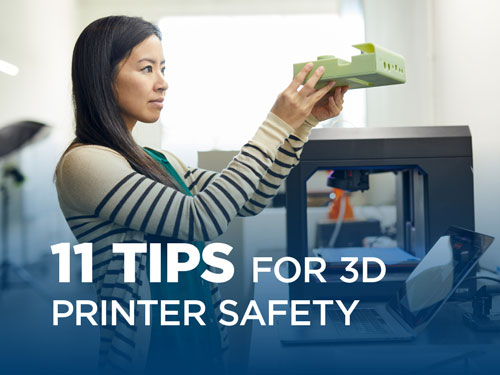
Are you diving into the world of 3D printers? Whether you’re a hobbyist, educator or business owner, understanding the safety considerations associated with 3D printers is essential. As these innovative machines become more common in schools, libraries and various industries, it’s crucial to prioritize safety to protect users and the environment.
We’ve compiled a list of practical tips to help you navigate the unique hazards of 3D printing.
Tips for 3D printer safety
- Ventilation matters
Place your 3D printers in a well-ventilated area to prevent the buildup of fumes and particles. If possible, use an enclosed rack or install a ventilation system to exhaust air containing harmful substances. If installing a ventilation system is not possible, think about placing printers away from high-traffic areas, ideally close to a window that can be opened. - Know your printer
Understand the type of printer you're using. For Fused Filament printers, be aware of the materials you're working with and their associated hazards. Common materials include PLA, ABS, Nylon, PET, PVA, PC, and HIPS. - Mind the VOCs
Watch out for volatile organic compounds (VOCs) emitted during printing. These can cause health issues, such as eye irritation and respiratory problems. Creating an enclosed space for the printer and ensuring proper ventilation can greatly reduce the amount of exposure to harmful substances. - Handle with care
Be cautious around the printer's heating elements to avoid burns. Allow printed parts to cool properly before handling. - Unseen risks
Be aware of ultrafine particles (UFPs), which are too small to see but can pose health risks. Good ventilation can help remove these particles from the air. - Consider vat photopolymerization printers
If using this type of printer, be mindful of VOCs, UV light exposure, and solvents used for finishing and cleaning. Use solvents in controlled areas as per safety guidelines. - Control strategies
Implement strategies to control emissions from your printers. Exhaust air containing fumes and particles either outdoors or through a HEPA filter with a charcoal bed to absorb VOCs. Focus on effective design rather than high airflow. - Metal fusion printers
If using metal fusion printers, be extra cautious due to higher heat generation and welding hazards. These should be places in areas suitable for “how work” activities such as welding and grinding, rather than in a classroom or office space. Follow manufacturer guidelines closely for safe operation. - Printer Maintenance
Once the printer cools down, make sure to clear away any built-up filament. Before each use, give the nozzle and build plate a good clean according to the manufacturer instructions. You can use a HEPA vacuum to get rid of any dust on the surface. - Seek expert advice
If you're unsure about your 3D printer setup or planning a new purchase, consider reaching out to experts for guidance on safety measures and best practices. You can contact losscontrol@emcins.com for assistance. - Stay informed
Keep yourself updated on safety recommendations and ventilation strategies for 3D printers to ensure a safe working environment.
By following these simple yet effective safety tips, you can mitigate risks associated with 3D printing and create a safer environment for yourself and those around you. As this technology continues to advance, it’s important to acknowledge that not all risks are fully understood. Stay informed, stay vigilant, and enjoy the limitless possibilities of 3D printing with peace of mind.
Learn more about 3D printer safety:
- Approaches to Safe 3D Printing, Center for Disease Control and Prevention
- Safe Use of 3D Printing for Institutions of Higher Education, Underwriters Laboratories Inc.